Common Staffing Failures in Summer Camp Injury Cases
Updated: 2 days ago

When evaluating a summer camp injury case, attorneys often focus first on the incident itself—a drowning, serious fall, assault, transportation accident, or other significant event.
In some matters, however, the operational issues extend beyond the immediate incident and involve staffing decisions made well beforehand.
Based on decades of camp leadership and risk-management experience, several staffing areas commonly warrant examination in camp-related litigation.
Staff Screening
Staff screening involves more than conducting a background check.
Depending on the position and circumstances, a camp's hiring process may also include:
Reference checks
Interviews designed to assess judgment and suitability
Review of prior experience
Verification of qualifications
Evaluation of an applicant's ability to supervise children
Consideration of an applicant's ability to respond appropriately in emergencies
When concerns or relevant information are missed during the hiring process, those issues may later become important in evaluating supervision or safety systems.
Staff Training
The existence of a training manual or orientation program does not necessarily establish that staff were adequately prepared for the responsibilities they ultimately assumed.
Areas that may warrant examination include training related to:
Camper supervision
Managing challenging or high-risk behavior
Recognizing medical emergencies
Responding to allegations of misconduct
Maintaining accountability during transitions
Activity-specific safety procedures
Implementing emergency action plans
Escalating concerns to camp leadership
A useful analysis often considers not only what training was scheduled, but also what staff were actually taught, how expectations were communicated, and whether staff demonstrated an understanding of their responsibilities.
Staffing Ratios
Counselor-to-camper ratios can be relevant, but a staffing ratio that appears adequate on paper may not reflect actual operating conditions.
Factors that may affect supervision needs include:
Camper age and maturity
Activity risk level
Physical environment
Behavioral concerns
Medical or developmental needs
Staff experience
The number of staff actually available at the time
The important question may therefore be not simply how many staff members were employed by the camp, but whether enough appropriately qualified staff were actively supervising at the relevant time and location.
Staff Placement and Deployment
Even qualified and well-trained staff may be ineffective if they are assigned improperly.
Issues may include:
Inexperienced staff assigned to higher-risk activities
Personnel without appropriate qualifications overseeing specialized program areas
Staff placed in roles for which they received insufficient preparation
Inadequate leadership presence during demanding activities
Staffing assignments that leave critical areas without effective supervision
In some incidents, the operational issue may therefore involve deployment rather than the camp's overall number of employees.
Active Supervision
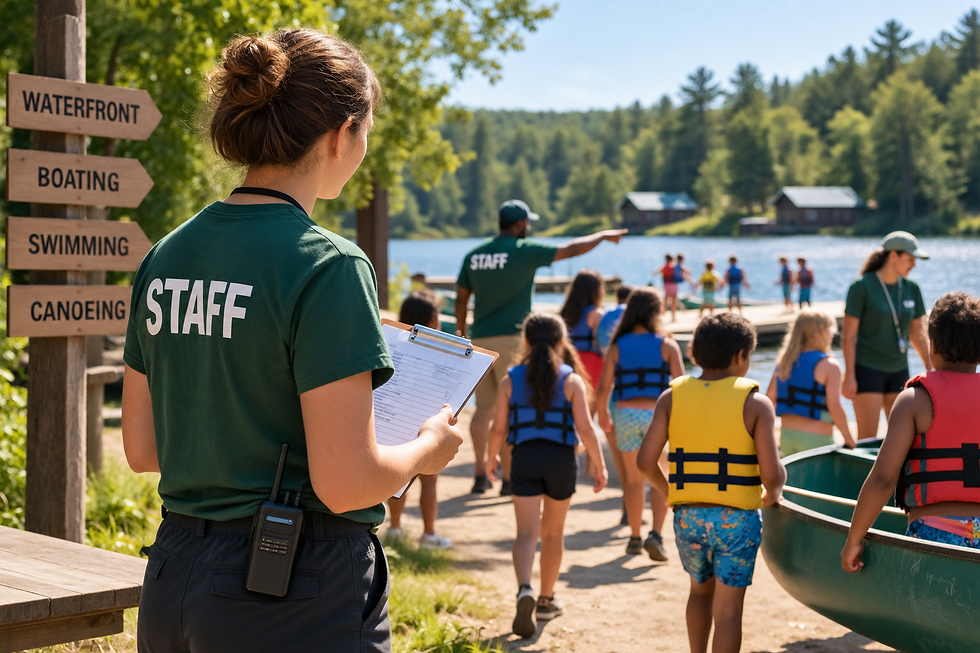
A recurring issue in camp-related matters is the distinction between staff being physically present and staff actively supervising.
Effective supervision generally requires attention, engagement, monitoring, and appropriate response to changing conditions.
Staff members who are distracted, multitasking, socializing, completing administrative duties, or otherwise focused elsewhere may be present without providing meaningful supervision.
An evaluation may therefore need to consider what staff were actually doing—not merely whether they were nearby.
Leadership and Oversight
Staff supervision does not end with counselors.
Questions may also arise concerning how camp leadership monitored, supported, and corrected staff performance.
Relevant issues may include:
Who supervised frontline staff?
How were performance concerns identified?
How were policy violations addressed?
Were staff given feedback or additional training?
Did leadership recognize developing risks?
Were recurring concerns documented or escalated?
A camp's management and supervisory systems may be just as important as the actions of an individual staff member.
Looking Beyond the Immediate Incident
A serious injury may appear at first to result from a single event or decision.
A broader operational review, however, may reveal issues involving hiring practices,
training, staff deployment, supervision structures, or leadership oversight that help explain the circumstances surrounding the incident.
For attorneys handling camp-related litigation, examining those systems may provide information that is not apparent from an incident report or witness statement alone.
About Kevin Gordon
Kevin Gordon provides expert witness and consulting services relating to summer camp operations, supervision, staffing and training, safety, emergency response, aquatics, and
related youth-program issues.
With over 40 years of experience in camps and youth programming, his background includes camp ownership and direction, risk management, waterfront operations, staff supervision and training, consulting, and camp-industry leadership.
He accepts engagements from both plaintiff and defense counsel throughout the United States and Canada.
*This article provides general information concerning summer camp operations and staffing. It is not legal advice and does not express an opinion regarding any particular case, organization, incident, or party.