Evaluating Camp Emergency Response Following a Serious Injury
Updated: 2 days ago
When a serious injury occurs at a summer camp, the fact that an unfavorable outcome followed does not, by itself, mean that the camp's emergency response was deficient.
For attorneys evaluating such a case, the more useful question is whether the camp had reasonable systems in place—and whether staff appropriately implemented those systems under the circumstances.
A meaningful analysis generally begins with the timeline.
What happened? When was the injury recognized? Who was notified? What assessments or first aid occurred? When was emergency medical assistance requested? When did the injured person receive definitive care?
Even relatively short intervals can become important, but they should be evaluated in context rather than in isolation.
Emergency Planning
The camp's written emergency action plans, health-care policies, and staff procedures can help establish what was expected when a significant injury occurred.
Relevant questions may include whether the camp had procedures addressing:
Recognition and initial assessment of serious injuries
Notification of health-care personnel and camp leadership
Activation of emergency medical services
Stabilization and first aid while awaiting additional care
Communication with parents or guardians
Transportation or evacuation from remote program areas
The existence of a written policy, however, is only part of the analysis.
It may also be important to consider whether the procedure was practical for the camp's setting and whether staff were trained to implement it.
Staff Training and Decision-Making
Counsel may also need to examine the training and qualifications of the personnel involved in the response.
Depending upon the circumstances, that may include:
Counselors
Activity instructors
Lifeguards
Wilderness or outdoor-program staff
Nurses or other health personnel
Athletic trainers
Camp administrators
The relevant inquiry is often not whether every staff member possessed advanced medical knowledge.
Rather, the question may be whether personnel recognized circumstances requiring escalation and followed the camp's established chain of response.
Communication Systems
Emergency response can be significantly affected by the camp's communication infrastructure.
At a large or geographically dispersed property, an important operational question is how staff were expected to summon assistance from locations such as:
Cabins
Waterfronts
Athletic fields
Trails
Remote activity areas
Off-site programs
Potentially relevant systems may include:
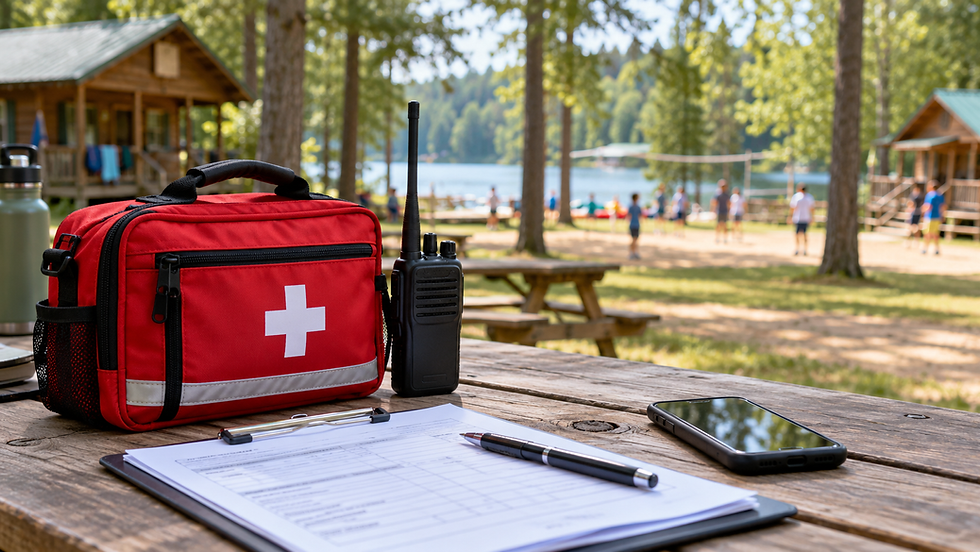
Radios
Cell phones
Landlines
Emergency telephone numbers
Backup communication methods
Procedures for contacting the health center
Procedures for contacting EMS or camp leadership
A written emergency plan may be difficult to implement effectively if staff lack a reliable means of communicating when an emergency occurs.
EMS Access and Transportation
A camp's location can materially affect emergency planning.
A facility located only minutes from definitive medical care may face different logistical issues than a rural or wilderness camp located significantly farther away.
Depending upon the matter, the analysis may include:
Expected EMS response times
Ambulance access to different areas of the property
Gates, roads, signage, and designated meeting locations
Whether staff were assigned to direct emergency vehicles
Availability and appropriate use of camp transportation
Procedures for emergencies occurring during off-site activities
Distance from medical care is not necessarily evidence that a camp's practices were deficient.
It may, however, make advance planning and prompt activation of emergency resources particularly important.
Implementation Versus Policy
An important distinction in many camp-related matters is the difference between a deficient system and a failure to follow an otherwise reasonable system.
If a camp had an appropriate emergency procedure but an individual employee departed from it, the issues may involve training, supervision, or individual decision-making.
If no meaningful procedure existed for a foreseeable emergency, the analysis may instead raise broader questions regarding camp administration and risk management.
That distinction can be important both to discovery and to expert analysis.
Documentation and Witness Evidence
Written incident reports may be useful, but they rarely tell the entire story.
Other evidence may help reconstruct what actually occurred, including:
Medical records
EMS reports
Radio logs
Telephone records
Staff schedules
Training records
Photographs
Maps
Witness testimony
Contemporaneous records may be particularly useful in establishing what occurred and when.
Counsel may also want to distinguish between materials that existed before or during the incident and policies, recollections, or explanations developed afterward.
Evaluating the Response as a Whole
Emergency situations are dynamic, and staff may be required to make decisions quickly with incomplete information.
The appropriate analysis is therefore not whether the response appears perfect in hindsight.
A camp-operations review instead considers whether the camp reasonably anticipated foreseeable emergencies, established systems for addressing them, prepared its personnel to use those systems, and responded appropriately to the circumstances presented.
For attorneys, it may also be useful to distinguish operational questions from medical-causation questions.
A camp-operations expert may evaluate emergency procedures, training, supervision, communication, and implementation, while medical experts address whether an alleged delay or deficiency affected the injured person's medical outcome.
About Kevin Gordon
Kevin Gordon provides expert witness and consulting services relating to summer camp operations, supervision, staffing and training, safety, emergency response, aquatics, and related youth-program issues.
With over 40 years of experience in camps and youth programming, his background includes camp ownership and direction, risk management, waterfront operations, staff supervision and training, consulting, and camp-industry leadership.
He accepts engagements from both plaintiff and defense counsel throughout the United States and Canada.
*This article provides general information concerning summer camp operations and emergency response. It is not legal advice and does not express an opinion regarding any particular case, organization, incident, or party.